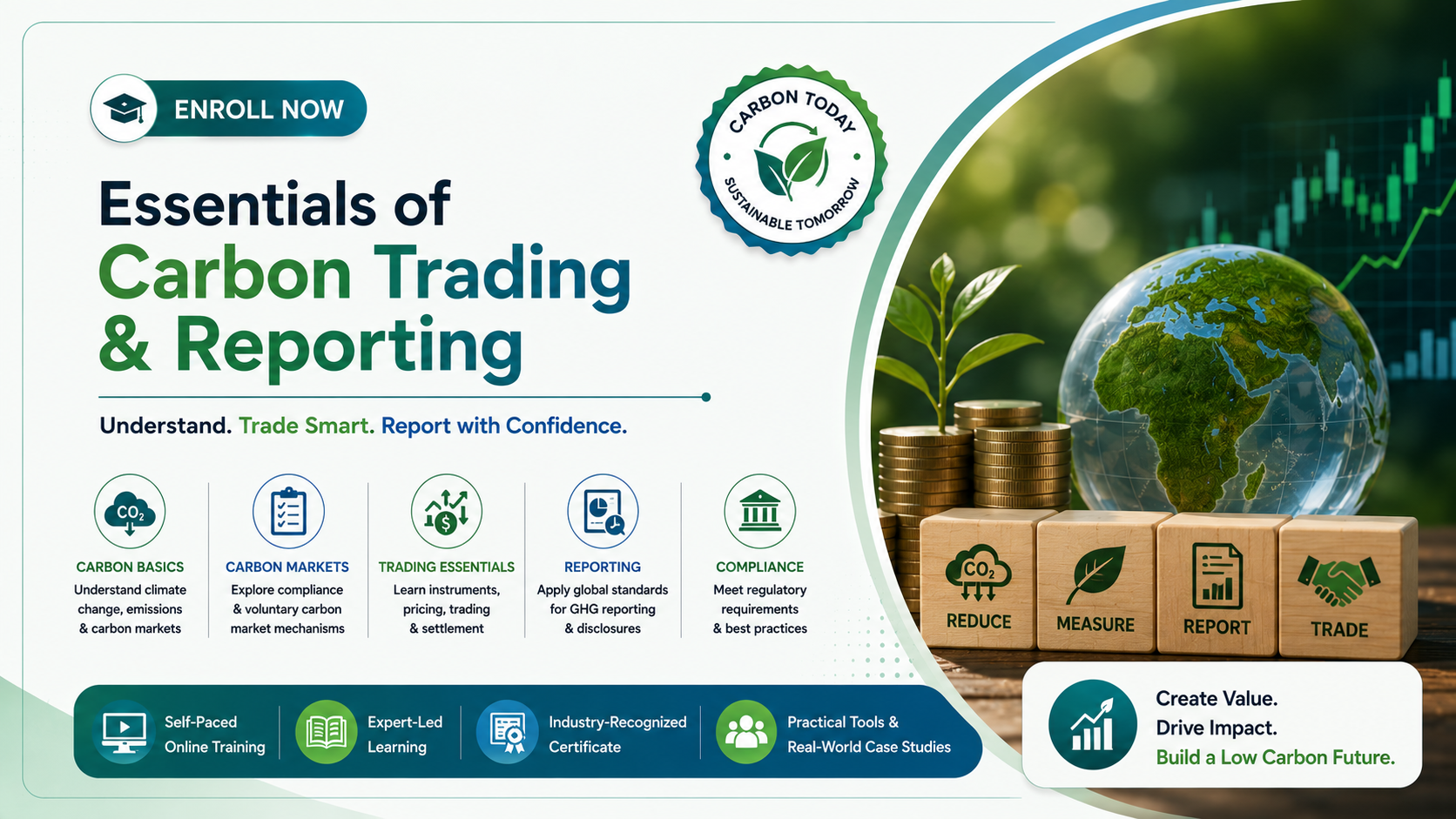
Understanding Carbon Credits, GHG Reporting, Compliance and Decarbonization in India
Created by SF Trainings Team
Essentials of Carbon Trading & Reporting is a beginner-friendly foundation course designed to help learners understand India’s emerging carbon market and greenhouse gas compliance framework.
The course explains how carbon credits are calculated, generated, purchased, traded, reported and surrendered under India’s Carbon Credit Trading Scheme (CCTS), 2023. It also introduces Greenhouse Gas Emission Intensity targets, emissions monitoring, GHG accounting, compliance reporting, verification requirements and environmental compensation for non-compliance.
Through practical examples and industry-based case studies, learners will develop skills in preparing GHG monitoring plans, calculating direct and indirect emissions, managing activity data, establishing QA/QC systems and preparing industrial emissions reports.
You will learn to:
India’s Carbon Market
Understand the structure, purpose and governance of the Carbon Credit Trading Scheme, 2023.
Carbon Credit Calculations
Calculate credits generated or required using target and achieved greenhouse gas emission intensity.
GHG Emission Intensity
Understand baselines, reduction targets, production-based intensity and annual compliance requirements.
Emissions Monitoring
Identify emission sources and monitor fuel, electricity, production and other industrial activity data.
GHG Accounting
Calculate direct, indirect and process emissions using activity data, emission factors and oxidation factors.
Monitoring Plans
Develop practical GHG monitoring plans with defined boundaries, data sources and reporting responsibilities.
Reporting and Documentation
Prepare industrial GHG reports, compliance forms, supporting records and audit trails.
Quality Assurance and Control
Apply QA/QC procedures to improve the accuracy, consistency and reliability of emissions data.
Verification Readiness
Organise records, calibration certificates and supporting evidence for carbon audits and verification.
Carbon Trading
Understand credit issuance, banking, purchasing, trading, surrender and registry operations.
Carbon Projects and Offsets
Explore project development, additionality, validation, verification and recognised offset mechanisms.
Compliance and Penalties
Understand certificate shortfalls, environmental compensation and enforcement for non-compliance.
Global Carbon Markets
Compare compliance and voluntary markets, international climate mechanisms and major trading systems.
Decarbonisation Strategies
Develop low-carbon action plans using energy efficiency, renewable energy and fuel-switching measures.
Practical Application
Apply carbon calculations, reporting, trading and reduction strategies through industrial case studies.
Join thousands of learners and build in-demand skills.