Practical PRP Auditing, Evidence Evaluation, Nonconformity Writing & Corrective Action Assessment
Created by SF Trainings Team
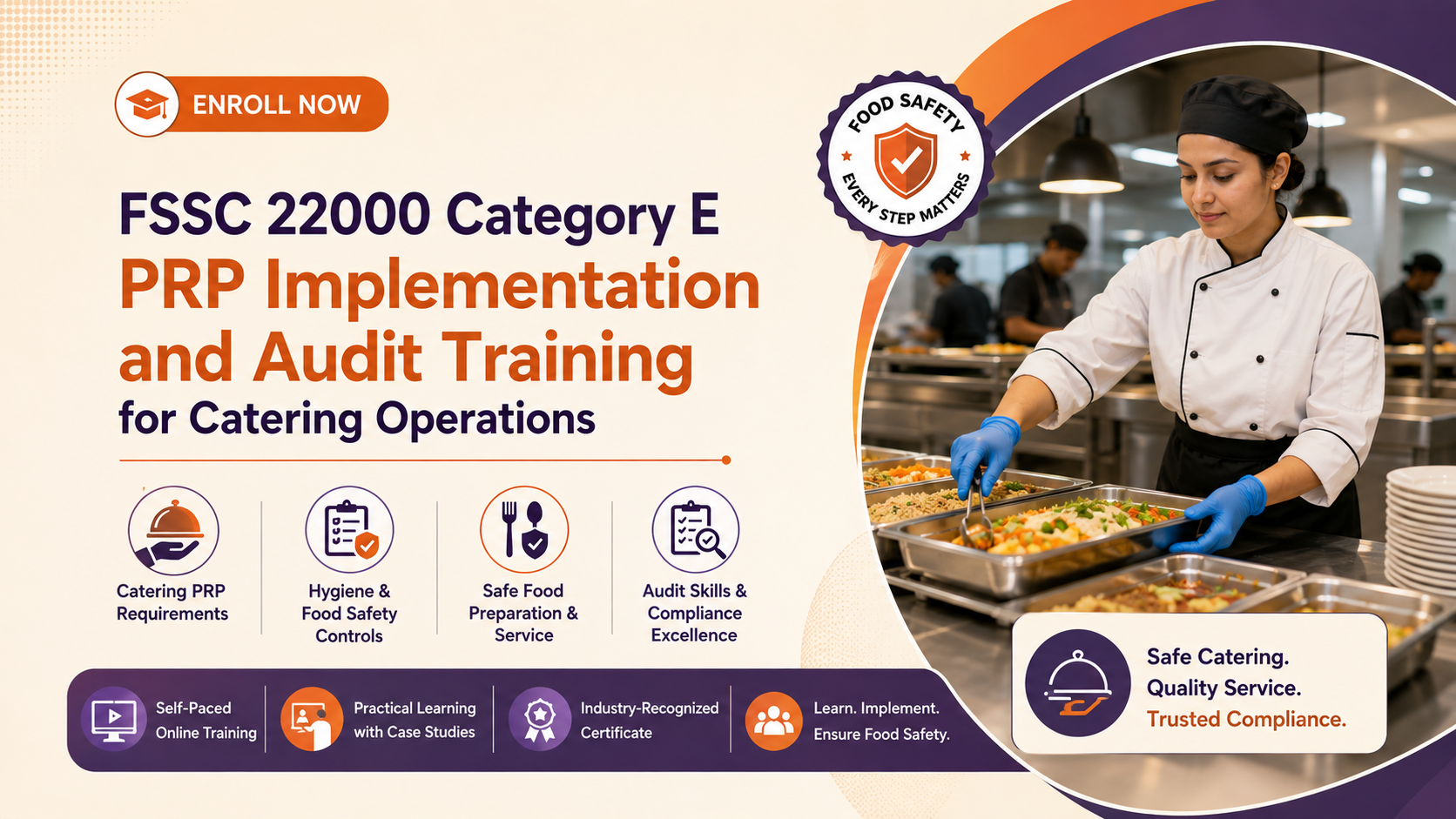
This course provides practical, audit-focused training on Prerequisite Programmes (PRPs) for catering and food service operations under FSSC 22000 Version 6 Category E, ISO 22000:2018, and ISO/TS 22002-2:2013.
It covers the complete range of PRP controls required in catering environments, including facility and hygienic design, utilities, waste management, equipment controls, raw material and storage practices, allergen management, cleaning and sanitation, pest control, personnel hygiene, cooking, holding, transport, service, and leftover management.
The course goes beyond theoretical requirements by showing participants how PRPs operate under real conditions in hotels, cafeterias, central kitchens, cloud kitchens, institutional catering facilities, event kitchens, and satellite service locations.
A strong emphasis is placed on auditor application. Learners will practice gathering objective evidence through observation, interviews, and record review; identifying food safety risks; evaluating PRP effectiveness; classifying findings; writing clear nonconformities; and assessing corrective actions.
Through practical examples, audit checkpoints, evidence-based exercises, case studies, and assessments, participants will develop the skills needed to confidently evaluate whether catering PRPs are suitable, implemented, maintained, and effective in protecting food safety.
You will learn to:
PRP Fundamentals
Understand the purpose of prerequisite programmes and how PRPs support food safety controls within FSSC 22000 catering operations.
Facility & Hygienic Design
Evaluate kitchen layout, zoning, utilities, drainage, waste flow, hygienic infrastructure, and equipment suitability.
Raw Material Controls
Assess supplier approval, goods receipt, ingredient acceptance, traceability, and incoming material food safety controls.
Storage & Stock Management
Evaluate dry, chilled, and frozen storage, labeling, FIFO, FEFO, segregation, and temperature control practices.
Cross-Contamination Prevention
Identify contamination routes and evaluate controls separating raw, cooked, and ready-to-eat foods.
Allergen Management
Assess allergen identification, segregation, labeling, recipe control, cleaning verification, and service communication.
Cleaning & Sanitation
Evaluate cleaning schedules, disinfection methods, chemical controls, sanitation verification, and cleaning-tool management.
Pest Control
Assess pest prevention, monitoring systems, inspection records, trend analysis, and corrective actions.
Personnel Hygiene
Evaluate hand hygiene, workwear, illness reporting, wound control, employee behaviour, and safe food-handling practices.
Cooking & Temperature Control
Assess thawing, preparation, cooking, cooling, reheating, hot holding, and cold holding controls.
Transport & Food Service
Evaluate dispatch, transportation, buffet display, replenishment, service conditions, and consumer-facing food safety controls.
Leftover Management
Assess the identification, storage, reuse, reheating, or safe disposal of leftover food.
Audit Evidence Gathering
Use observation, interviews, records, and operational evidence to verify whether PRP controls are actually implemented.
Risk-Based Audit Trails
Follow food flow and select meaningful samples to evaluate PRP effectiveness under real catering conditions.
Nonconformity Writing
Write clear audit findings that connect applicable requirements, objective evidence, control failures, and food safety risk.
Corrective Action Evaluation
Evaluate root cause, correction, containment, corrective actions, effectiveness, and prevention of recurrence.
Join thousands of learners and build in-demand skills.