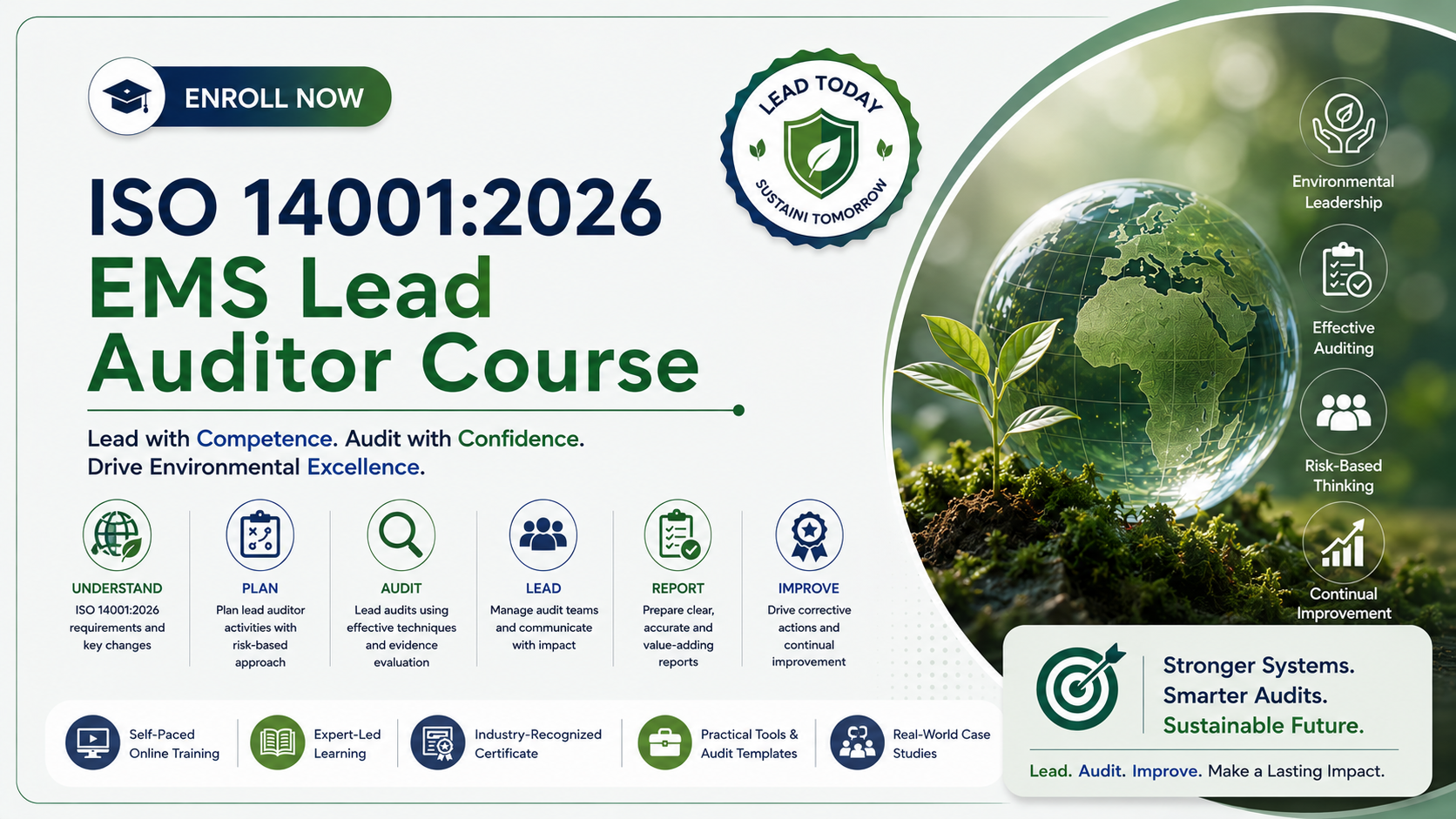
ISO 14001:2026 Environmental Management System Auditing – Requirements, Evidence and Practical Application
Created by SF Trainings Team
This course provides a comprehensive understanding of ISO 14001:2026 Environmental Management System requirements and auditing practices, with a strong focus on evidence-based implementation, evaluation, and continual improvement.
Learners will explore the complete EMS framework, including organizational context, environmental conditions, leadership accountability, risks and opportunities, environmental aspects, life cycle perspective, operational controls, competence, communication, documented information, performance evaluation, internal auditing, management review, corrective action, and continual improvement.
The course emphasizes a practical auditing approach that goes beyond checking procedures and records. Learners will develop the ability to connect requirements across Clauses 4 to 10, ask effective audit questions, evaluate objective evidence, identify implementation gaps, and determine whether environmental controls are genuinely effective.
Through practical examples, activities, case-based learning, and audit-focused scenarios, participants will learn how to assess EMS conformity, environmental performance, compliance obligations, operational effectiveness, and improvement actions within real organizational settings.
The programme is suitable for professionals preparing to perform Lead Auditor or Internal Auditor responsibilities, as well as environmental, sustainability, compliance, and management professionals seeking a deeper understanding of ISO 14001:2026.
By completing the course, learners will be prepared to apply a clear audit approach: understand the requirement, trace the connection, verify the evidence, and evaluate effectiveness.
You will learn to:
ISO 14001:2026 Requirements
Understand the structure, intent, and practical application of ISO 14001:2026 EMS requirements.
Organizational Context
Evaluate internal and external issues, environmental conditions, and interested-party expectations affecting the EMS.
Leadership & Accountability
Assess top management commitment, environmental policy, responsibilities, resources, and leadership involvement.
Environmental Aspects & Impacts
Identify and evaluate environmental aspects, impacts, significance, and associated organizational controls.
Risks & Opportunities
Understand how environmental risks and opportunities are identified, evaluated, addressed, and monitored.
Life Cycle Perspective
Apply life cycle thinking to activities, products, services, procurement, suppliers, and end-of-life considerations.
Environmental Objectives & KPIs
Develop and evaluate measurable environmental objectives, targets, KPIs, and supporting action plans.
Operational Planning & Control
Assess whether environmental controls are appropriately designed, implemented, monitored, and maintained.
Competence & Awareness
Verify whether personnel have the competence, awareness, and understanding needed to perform environmentally relevant activities.
Communication & Documentation
Evaluate internal and external communication and the effectiveness of EMS documented information controls.
Emergency Preparedness
Assess environmental emergency risks, preparedness arrangements, response procedures, testing, and improvement.
Evidence-Based Auditing
Move beyond checklist auditing by verifying implementation through records, interviews, observations, and performance evidence.
Audit Questioning Techniques
Develop effective audit questions that test conformity, implementation, process linkages, and EMS effectiveness.
Internal Audit Programme
Understand audit planning, objectives, scope, criteria, evidence collection, reporting, and follow-up activities.
Performance Evaluation
Evaluate monitoring, measurement, environmental indicators, compliance evaluation, and performance trends.
Management Review
Assess management review inputs, outputs, leadership decisions, resource requirements, and improvement actions.
Nonconformity & Root Cause
Identify EMS nonconformities and evaluate root cause analysis, correction, and corrective action.
Corrective Action Effectiveness
Verify whether corrective actions address actual causes, prevent recurrence, and produce measurable results.
Continual Improvement
Evaluate how audit findings, monitoring data, incidents, trends, and management reviews drive EMS improvement.
Audit Evidence & Conclusions
Collect, evaluate, and connect objective evidence to form reliable and defensible audit conclusions.
Join thousands of learners and build in-demand skills.